Interview · Business Women Nederland · Dutch publication
Your business is growing. Is its value growing too?
About control, growth and company value — and why cash flow, organisation and owner independence determine whether a business genuinely becomes stronger.
In the magazine
View the three publication pages
The original magazine interview is in Dutch. Click a page to view it at a larger size; an English translation follows below.
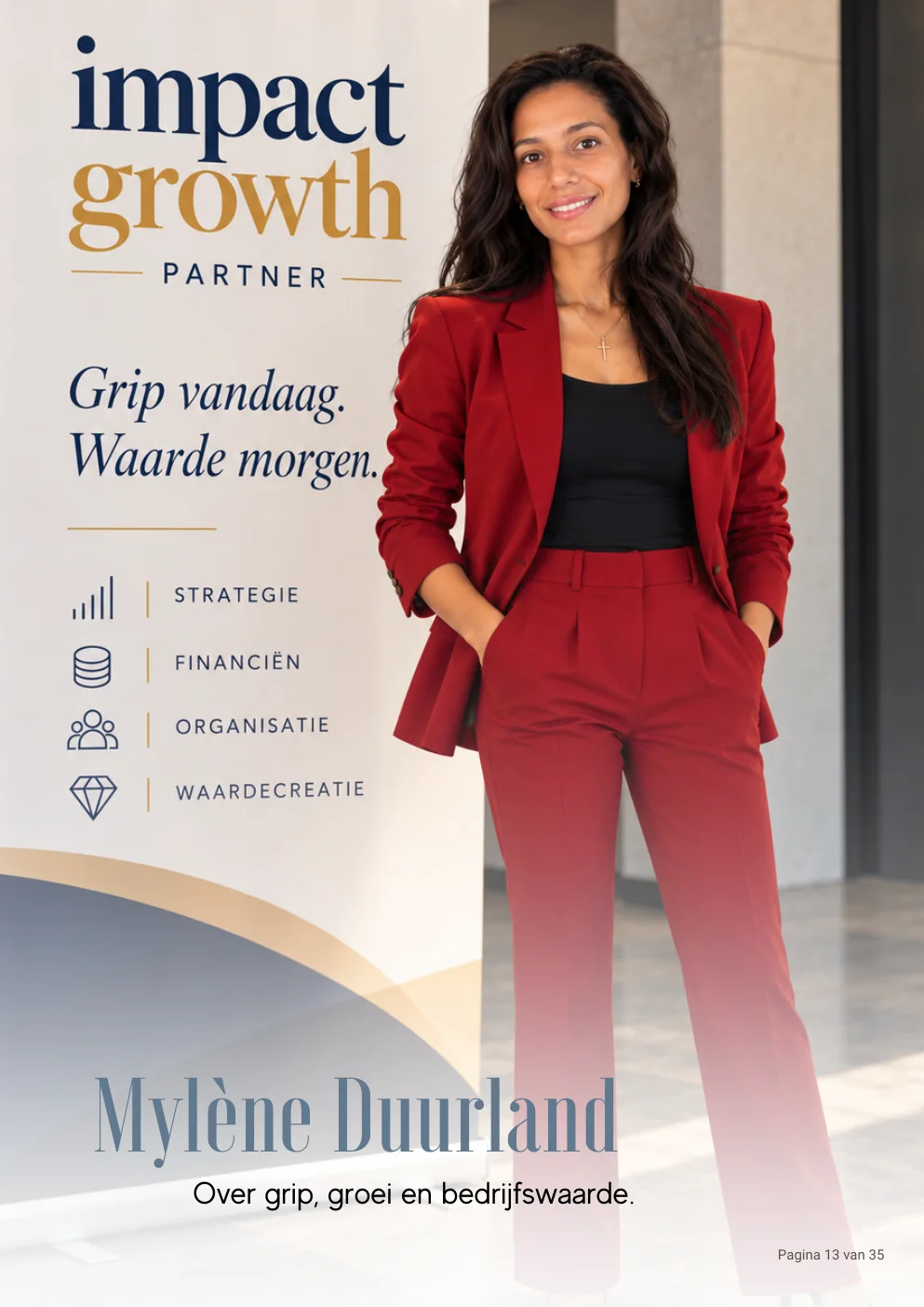
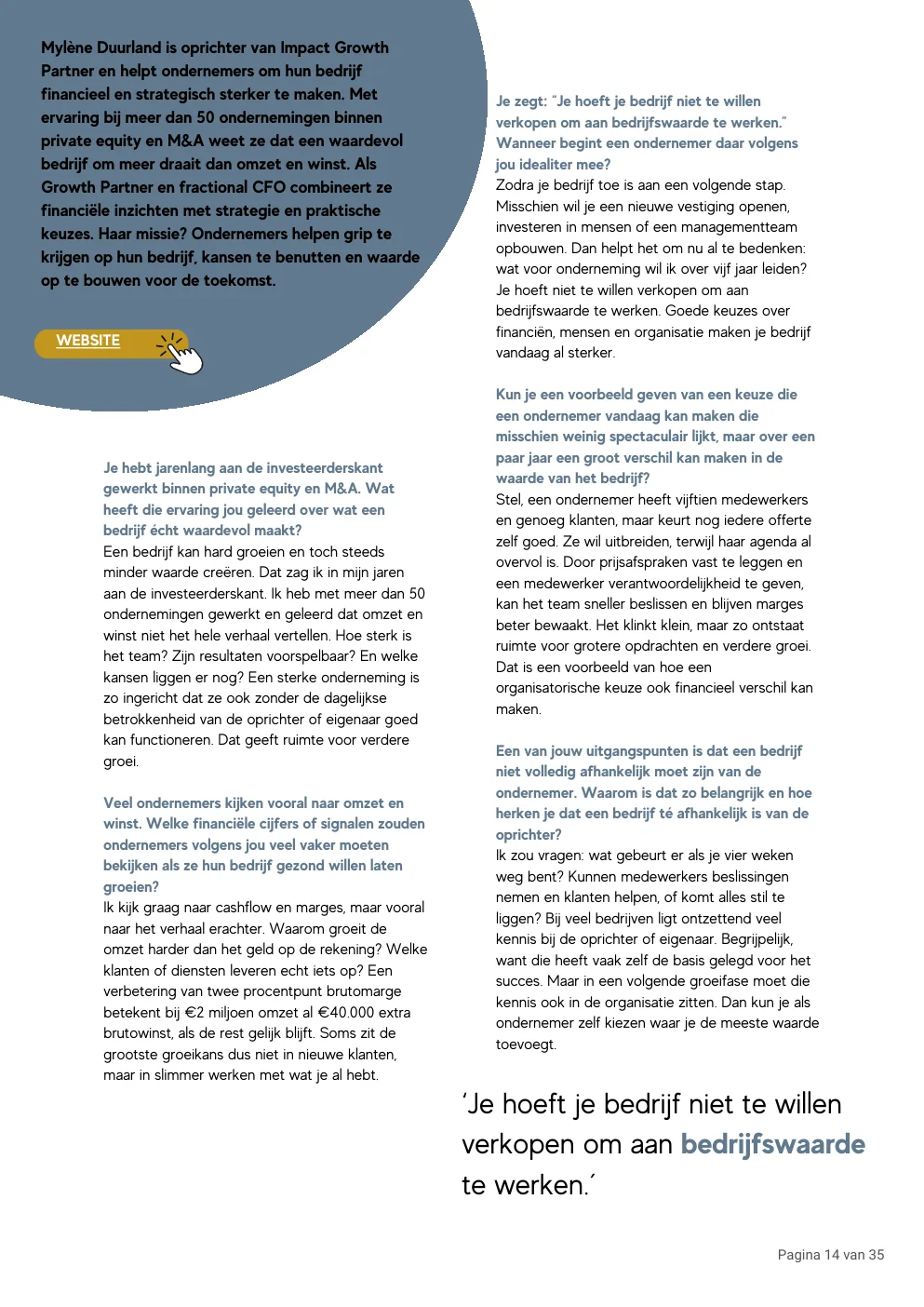
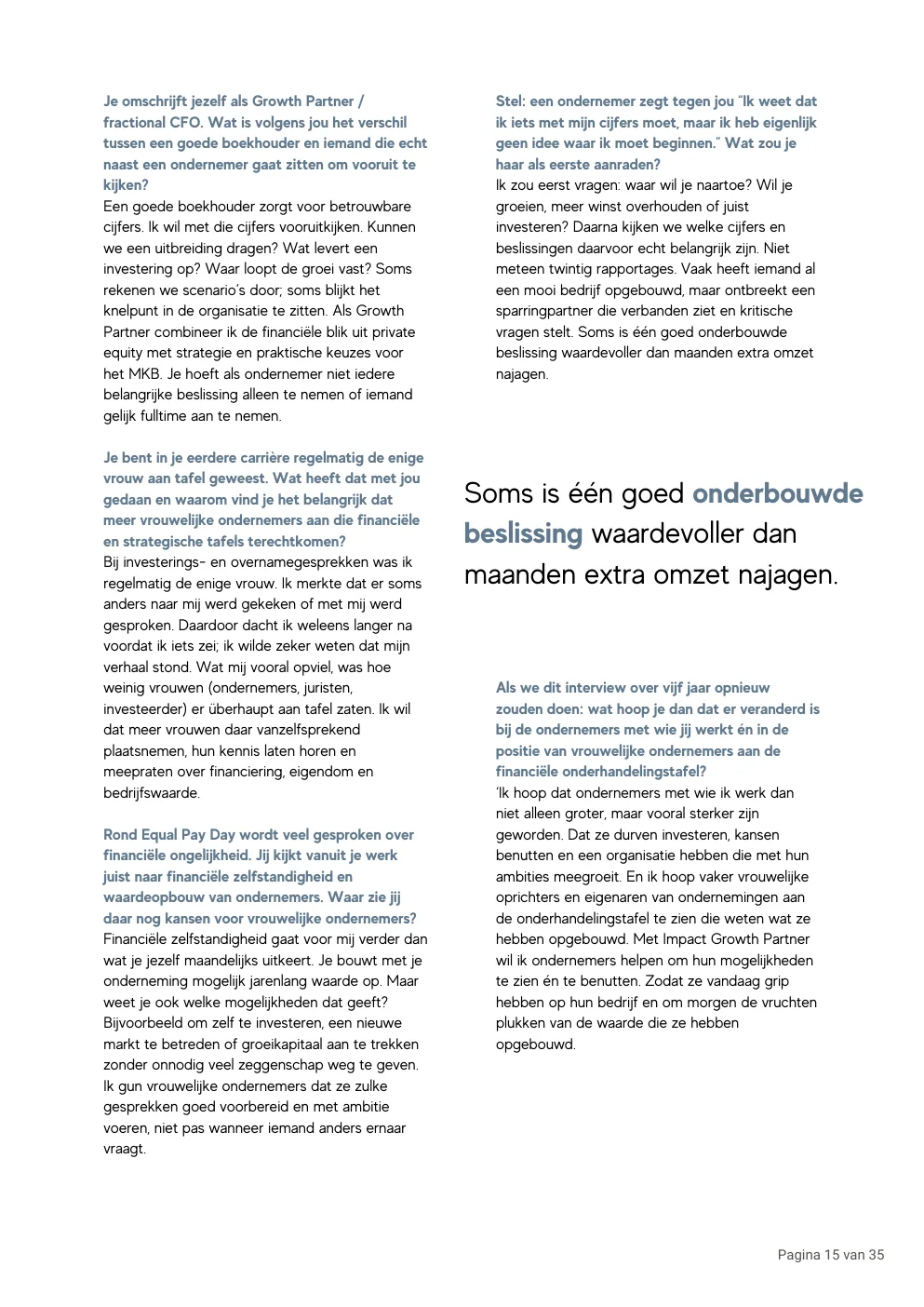
Mylène Duurland · On control, growth and company value
English translation of the interview
Mylène Duurland is the founder of Impact Growth Partner and helps business owners strengthen their companies financially and strategically. With experience across more than 50 companies in private equity and M&A, she knows that a valuable business is about more than revenue and profit. As a Growth Partner and fractional CFO, she combines financial insight with strategy and practical decisions. Her mission? Helping business owners gain control of their company, seize opportunities and build value for the future.
You spent years on the investor side in private equity and M&A. What did that experience teach you about what truly makes a business valuable?
A company can grow quickly and still create less and less value. I saw that during my years on the investor side. I have worked with more than 50 companies and learned that revenue and profit do not tell the whole story. How strong is the team? Are results predictable? And what opportunities still exist? A strong company is structured so it can operate well without the founder or owner being involved every day. That creates room for further growth.
Many business owners mainly look at revenue and profit. Which financial figures or signals should they monitor more often if they want to grow healthily?
I like to look at cash flow and margins, but especially at the story behind them. Why is revenue growing faster than the money in the bank? Which clients or services genuinely contribute? A two-percentage-point improvement in gross margin means €40,000 in additional gross profit at €2 million in revenue, assuming everything else remains equal. Sometimes the greatest growth opportunity is therefore not in new clients, but in working more intelligently with what you already have.
You say: “You do not have to want to sell your business to work on its value.” When should a business owner ideally start?
As soon as the company is ready for a next step. Perhaps you want to open another location, invest in people or build a management team. It helps to think now: what kind of company do I want to lead in five years? You do not have to want to sell to work on company value. Good decisions about finance, people and organisation make your company stronger today.
Can you give an example of a choice that may seem unspectacular today, but can make a major difference to company value in a few years?
Imagine an owner with fifteen employees and enough clients, who still approves every quotation personally. She wants to expand, while her diary is already full. By documenting pricing agreements and giving an employee responsibility, the team can decide faster and margins remain better protected. It sounds small, but it creates room for larger assignments and further growth. It shows how an organisational choice can also make a financial difference.
One of your principles is that a business should not depend entirely on its owner. Why is that so important, and how do you recognise excessive founder dependency?
I would ask: what happens if you are away for four weeks? Can employees make decisions and help clients, or does everything stop? In many companies, an enormous amount of knowledge sits with the founder or owner. That is understandable, because they often created the foundations for success. But in the next growth phase, that knowledge must also reside in the organisation. Then the owner can choose where they add the most value.
‘You do not have to want to sell your business to work on its value.’
You describe yourself as a Growth Partner / fractional CFO. What is the difference between a good bookkeeper and someone who sits beside an owner to look ahead?
A good bookkeeper provides reliable figures. I want to use those figures to look forward. Can we afford an expansion? What will an investment deliver? Where is growth getting stuck? Sometimes we model scenarios; sometimes the bottleneck turns out to be in the organisation. As a Growth Partner, I combine the financial perspective from private equity with strategy and practical choices for SMEs. A business owner does not have to make every important decision alone or immediately hire someone full-time.
Earlier in your career you were regularly the only woman at the table. What did that do to you, and why is it important that more women entrepreneurs reach those financial and strategic tables?
In investment and acquisition discussions I was regularly the only woman. I noticed that people sometimes looked at or spoke to me differently. That occasionally made me think longer before speaking; I wanted to be certain my argument was solid. What struck me most was how few women — entrepreneurs, lawyers or investors — were at the table at all. I want more women to take their place there naturally, make their knowledge heard and participate in discussions about financing, ownership and company value.
Around Equal Pay Day there is much discussion about financial inequality. Your work focuses on financial independence and value building. Where do you see opportunities for women entrepreneurs?
For me, financial independence goes beyond what you pay yourself each month. You may build value in your company for years. But do you know what opportunities that creates? For example, investing yourself, entering a new market or attracting growth capital without giving away unnecessary control. I want women entrepreneurs to enter those conversations well prepared and ambitiously, rather than only when somebody else raises the subject.
Suppose an owner says: “I know I need to do something with my figures, but I have no idea where to start.” What would you advise first?
I would first ask: where do you want to go? Do you want to grow, retain more profit or invest? Then we look at which figures and decisions genuinely matter. Not twenty reports straight away. Often someone has already built a strong company, but lacks a sparring partner who sees the connections and asks critical questions. Sometimes one well-supported decision is more valuable than chasing months of additional revenue.
Sometimes one well-supported decision is more valuable than chasing months of additional revenue.
If we repeated this interview in five years, what would you hope had changed for the owners you work with and for women entrepreneurs at the financial negotiating table?
I hope the owners I work with will not only have become larger, but above all stronger. That they dare to invest, seize opportunities and have an organisation that grows with their ambitions. And I hope to see more women founders and owners at the negotiating table who know what they have built. With Impact Growth Partner, I want to help entrepreneurs see and use their possibilities, so they have control of their company today and can reap the benefits tomorrow of the value they have built.

Mylène works with SME owners who need more than a bookkeeper but are not yet ready for a full-time CFO. Drawing on experience in finance, private equity and M&A, she translates numbers into clear choices about cash flow, profit, growth and business value. Together with business owners, she builds financially stronger, better organised and more transferable companies.
More about Mylène →